Roof Replacement Cost in West Georgia: What Drives the Price (2026 Guide)
"How much is a new roof?" is usually the first question we hear, often before anyone has seen the house. It's a fair question. A roof replacement is one of the biggest checks a homeowner ever writes.
Here's the honest answer: any number you get over the phone or off a website is a guess. Two houses on the same street in Douglasville can come in very differently because of things you can't see from the curb, like how steep the back slope is, how many layers are already up there, or what shape the wood underneath is in. That's why we don't post a price online. You deserve a number based on your roof, not your neighbor's.
What we can do is walk you through what actually moves the price, so the written estimate in your hand makes sense, whether it comes from us or anyone else.
1. How Big the Roof Really Is
Roofers measure in "squares." One square is 100 square feet of roof surface.
Your roof is bigger than your home's footprint. Overhangs add area, and the steeper the pitch, the more surface it takes to cover the same floor plan. Material is also ordered with some extra for waste, because shingles get cut to fit along hips, valleys and edges. A simple roof wastes very little. A roof with lots of angles wastes more.
2. How Steep and How High It Is
Pitch changes the whole job. A low, walkable roof lets a crew move freely. A steep roof needs roof jacks, harnesses and more time for every square, and it's slower to load and slower to tear off.
Height matters too. Two-story homes take more setup than ranches, and plenty of houses around Douglasville and Villa Rica sit on sloped lots with a walk-out basement, which can make the back of the house a full story taller than the front. Then there's access: where the dumpster can sit, how close a truck can get, and whether there's landscaping, a deck or a pool to protect.
3. How Complicated the Roof Is
Every valley, hip, dormer, skylight, chimney and wall intersection adds labor and flashing. A straight gable roof with two big planes is about as simple as it gets. A two-story house with several gables, a couple of dormers and a chimney on the slope has a lot more detail work, and detail work is where a roof either holds up for decades or starts leaking.
4. What's Coming Off
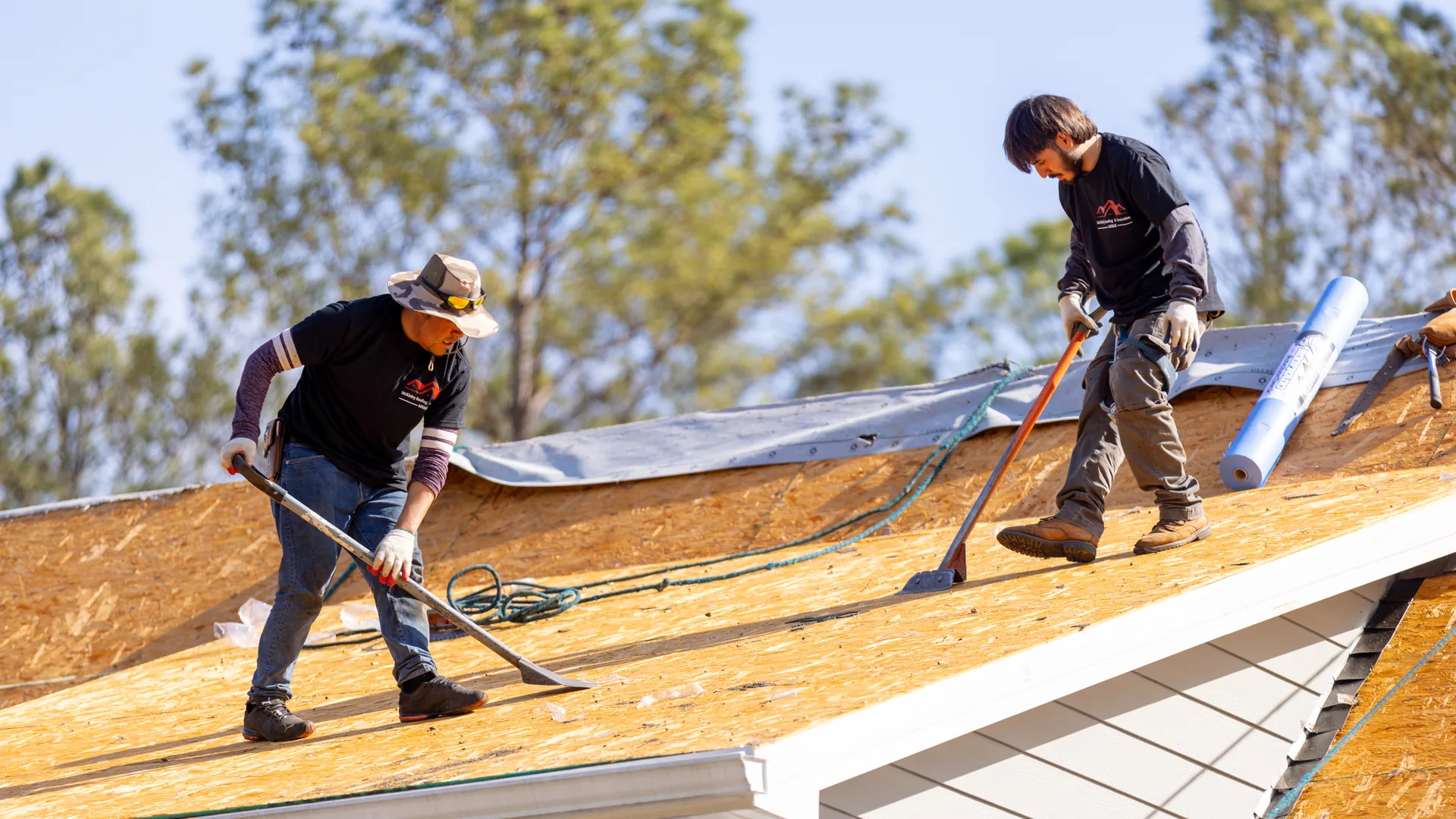
Most replacements start with a full tear-off down to the decking, and ours do. If your house already has two layers of shingles, both have to come off. Georgia's residential building code, which is based on the International Residential Code, doesn't allow a new layer of shingles over a roof that already has two. More layers means more labor, more weight to haul away and more disposal.
5. What's Under the Shingles
This is the one item nobody can measure perfectly in advance. Roof decking, the plywood or OSB sheets the shingles are nailed to, can be soft, rotted or coming apart in spots, especially around old leaks, valleys and chimneys. You often can't tell how much until the old roof is off.
A good estimate tells you up front how replacement decking will be handled and billed if the crew finds bad wood, so there's no surprise halfway through the job. If an estimate says nothing about decking, ask.
6. The Shingles and the System Under Them
Materials are the part you have the most say in:
- Shingle type. Basic three-tab shingles, thicker architectural (dimensional) shingles and premium designer lines all sit at different levels. Architectural shingles are what most homeowners choose today.
- Metal and other materials change both the material cost and the labor involved.
- Underlayment. This is the layer between the decking and the shingles. Synthetic underlayment is now the norm on most replacements.
- Ice-and-water membrane. West Georgia doesn't see much ice, but the same self-sealing membrane is what protects valleys and the areas around chimneys and vents from wind-driven rain.
- Drip edge, starter strips and ridge caps. Code requires drip edge along the eaves and rake edges of a shingle roof, and starter strips and ridge caps finish the system.
7. Ventilation, Flashing and the Small Parts
Attic ventilation affects how long shingles last. A balanced system pulls fresh air in at the soffits and lets hot air out at the ridge, and shingle manufacturers generally require proper ventilation to honor their warranties. If your attic runs hot every summer, a replacement is the easiest time to fix it.
Then there's the metal and rubber: step flashing along walls, flashing around the chimney, and the boots around plumbing vent pipes. Ask whether the estimate replaces them or reuses the old ones. On a roof that's being torn off anyway, old flashing is usually the weakest part left behind.
8. Permits and Local Code
Many jurisdictions require a building permit for a re-roof, and who issues it depends on where you live. In unincorporated Douglas County, roof work is one of the job types on the county's miscellaneous building permit application. Homes inside city limits generally go through the city instead, and Carroll, Paulding, Coweta and Haralson counties each run their own building departments.
Permit fees and inspections vary from place to place, and they belong in your estimate. Your contractor should pull the permit, not you.
9. Whether Insurance Is Paying for Part of It
If wind or hail damaged your roof, your homeowners policy may cover much of the replacement, and your share may come down to your deductible. How much depends on your policy. Actual cash value (ACV) policies subtract depreciation for the roof's age, while replacement cost value (RCV) policies hold back depreciation and release it once the work is done. Our guide to how roofing insurance claims work in Georgia explains the difference.
One rule worth knowing: Georgia law bars roofing contractors from advertising or promising to pay or rebate your deductible. A bid that "covers your deductible" isn't a deal. It's a red flag.
How to Compare Two Roofing Estimates
When two estimates are far apart, it's usually because they aren't describing the same roof. Line them up and check that both include:
- The same shingle line and the same underlayment
- Ice-and-water membrane in the valleys and around chimneys and vents
- Drip edge, starter strips and ridge caps
- Ventilation: what's being added or replaced
- New flashing and pipe boots, or reused
- How bad decking will be handled if the crew finds it
- Full tear-off, disposal and cleanup
- The permit
- Warranty terms in writing, from the manufacturer and on the workmanship
- A local address and proof of insurance
If one bid is a lot lower than the others, find out which of these it left out.
Where We Work
McKinley Roofing and Restoration is family-owned and based in Douglasville. We replace roofs across West Georgia, including Douglasville, Carrollton, Newnan, Villa Rica, Hiram, Dallas, Powder Springs, Lithia Springs, Austell and Bremen.
Frequently Asked Questions
Why won't you give me a price over the phone?
Because it would be a guess, and a guess either scares you off or surprises you later. Size, pitch, layers, decking and materials all change the number, and most of that can only be measured on the roof. A free inspection gets you a written estimate based on your actual house.
Can you put new shingles over my old roof to save money?
Code never allows a new layer over a roof that already has two, and laying over an old roof hides the decking underneath. If there's soft or rotted wood, you'd be nailing a new roof into it. That's why our replacements start with a full tear-off.
Will insurance pay for my roof replacement?
Only if the damage came from a covered event like wind or hail. Insurance doesn't pay to replace a roof that has simply worn out. If you've had a storm recently, get the roof inspected before you decide how to pay for a replacement.
Is the roof inspection really free?
Yes. The inspection is free and there's no obligation. You'll get an honest read on what your roof needs, and a written estimate if it needs work.
Get a Real Number for Your Roof
The only roof replacement cost that matters is the one for your house. Call (678) 983-4455 or request a free inspection on our Contact page. We'll look your roof over top to bottom and give you a written estimate you can compare line by line.
McKinley Roofing and Restoration · Douglasville, GA